
Finalist
Serious Condition, Serious Coverage. The Allergy Reset
Summary of work
Allergic rhinitis is widely dismissed as a minor inconvenience, yet for millions of people in the UK it is a debilitating, chronic condition that disrupts sleep, work, school, and quality of life. Despite significant personal and system-level burden, care has long focused on short-term symptom management rather than addressing the underlying cause. Against a backdrop of overstretched allergy services, rising cost-of-living pressures, and increasingly severe hay-fever seasons, this programme set out to change how allergic rhinitis is covered by the media, and illustrate the burden.
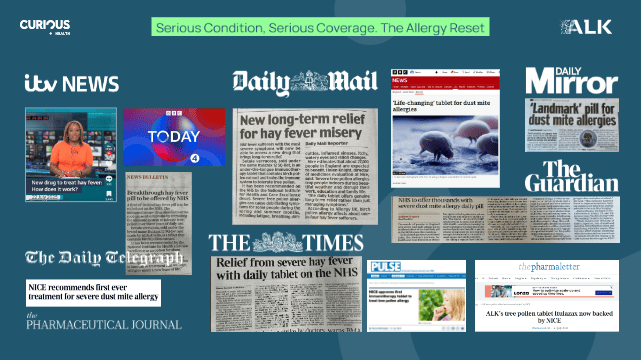
We delivered a media relations strategy around two first-of-their-kind NICE approvals for disease-modifying sublingual immunotherapy tablets for house dust mite allergy and birch pollen allergy. Our approach reframed allergic rhinitis as a serious condition with viable, long-term treatment options now available on the NHS, aligning communications with NICE milestones.
Through insight-led storytelling and close collaboration with NICE, Allergy UK, BSACI, and clinical experts, we achieved high-quality national coverage with exceptional message fidelity. By aligning our earned media strategy with regulatory milestones, challenging media perceptions of this being a ‘seasonal’ topic, and optimising for LLMs, the programme demonstrated how modern media relations can shape not just coverage, but how health information is found, trusted, and understood.
Judges’ comments
‘The Allergy Reset’ entry was well written. It had a good breakdown of measurements and outputs. The judges liked the way the entry played on the cost-of-living crisis. It had good framing of the need to switch from lifestyle to serious condition to avoid trivial response that only ever scratches the surface. Succeeded in moving it up a notch or two from 'mild inconvenience'.