
Finalist
AI-Generated Plain Language Summary Patient Preference
by Prime, on belhalf of Pfizer
Summary of work
Shared decision-making between healthcare professionals (HCPs) and patients can improve treatment outcomes and patient satisfaction, but the science to support this can be inaccessible for some patients due to the complex technical language used in scientific publications. Plain Language Summaries (PLS) can bridge this gap, but the cost and time investment required to develop PLS may be prohibitive, meaning that PLS are prioritised for certain studies only.
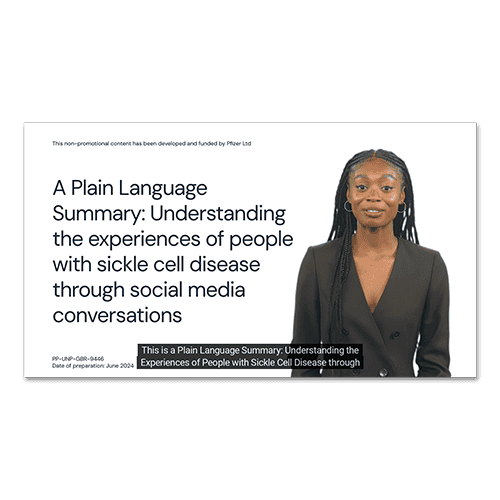
We explored potential of generative artificial intelligence (GenAI) to create PLS efficiently and cost-effectively. Partnering with Pfizer, we leveraged their GenAI tool, MAIA, to generate a PLS from a social media-listening study in the UK sickle cell community. We assessed patient preference across three written PLS: AI-generated, AI-generated with patient editing, and human-written, and assessed patient preference for AI-generated video PLS vs written.
Our randomised, blinded study of 93 sickle cell patients and caregivers revealed that GenAI PLS were as understandable and effective as the human-written version. Notably, 58% of participants preferred video PLS over written, underscoring the growing demand for video-based medical communications.
GenAI can generate PLS as understandable as human writers. This could reduce the time and cost of PLS generation and make scientific information more accessible and engaging for patients.
Judges’ comments
‘AI-Generated PLS Patient Preference’ is interesting and shows that using AI makes it easier to educate. The study was strong and the judges could see it would have a broad application.